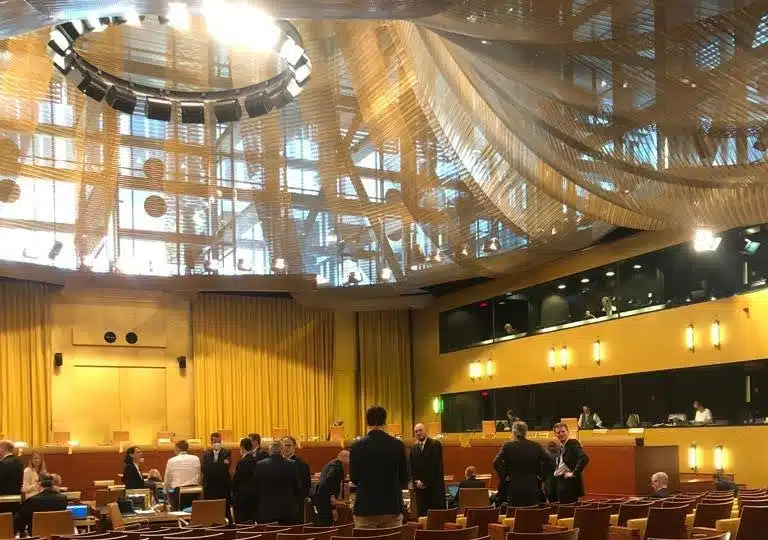
The Court of Justice delivered its judgment in Brasserie Nationale and Munhowen v Commission (C‑572/25 P) on 8 October 2026. The ruling clarifies when the 15-working-day period for an Article 22 EUMR referral starts where no national merger notification is required. As of 9 October 2026, the full judgment is available on CURIA in French only. The Court leaves the limits established in Illumina/Grail intact and addresses a narrow procedural issue arising in the exceptional Luxembourg setting.
It confirms that mere awareness of a transaction by a national competition authority is not sufficient. The deadline starts only once the authority has actively received sufficient information to make a preliminary assessment of whether the conditions for an Article 22 referral are met.
Therefore, the practical scope of the judgment is narrow.
A narrow Article 22 issue after Illumina/Grail
The judgment must be read against Illumina/Grail. There, the Court rejected the Commission’s broader interpretation of Article 22 EUMR. A national competition authority cannot generally refer a transaction which it is not competent to review under its own national merger control rules. Article 22 therefore does not provide a general mechanism for circumventing national merger control thresholds.
Referring that, Brasserie Nationale does not qualify that conclusion. The case concerns Luxembourg, which had no national merger control regime when the transaction took place and still has no general ex-ante merger control regime today. Luxembourg is therefore an exceptional case.
The Luxembourg Competition Authority is currently developing a structured procedure for companies to communicate information about transactions that could potentially be referred to the Commission under Article 22. The initiative is expressly intended to operate pending the introduction of national merger control.
When does the 15-working-day period start?
The Court decided: Where no national notification is required, Article 22(1) EUMR provides that a referral request must be made within 15 working days of the concentration being “made known” to the Member State.
The Court held that mere knowledge of the existence of the transaction is not enough. There must be an active transmission of information that enables the national authority to carry out a preliminary assessment of whether the transaction may affect trade between Member States and threaten significantly to affect competition in that Member State.
This communication is not a formal merger notification. Nor does Article 22 make such a communication a prerequisite for a referral. Its relevance is procedural: Only sufficiently detailed information starts the 15-working-day referral period.
No new referral route below German merger control thresholds
The judgment therefore does not revive the approach rejected in Illumina/Grail.
For German merger control, in particular, it does not create a new Article 22 route for transactions falling outside the jurisdiction of the Bundeskartellamt merely because the German notification thresholds are not met.
Where a national merger notification is required, Article 22 already links the referral deadline to that notification. Brasserie Nationale clarifies the much narrower alternative: what starts the clock where no national filing is required at all.
The judgment is therefore best understood as a clarification of the procedural mechanics of Article 22 in an exceptional setting, rather than as an expansion of EU merger control jurisdiction.
For a broader overview of the German merger control regime, see our guide to German merger control.